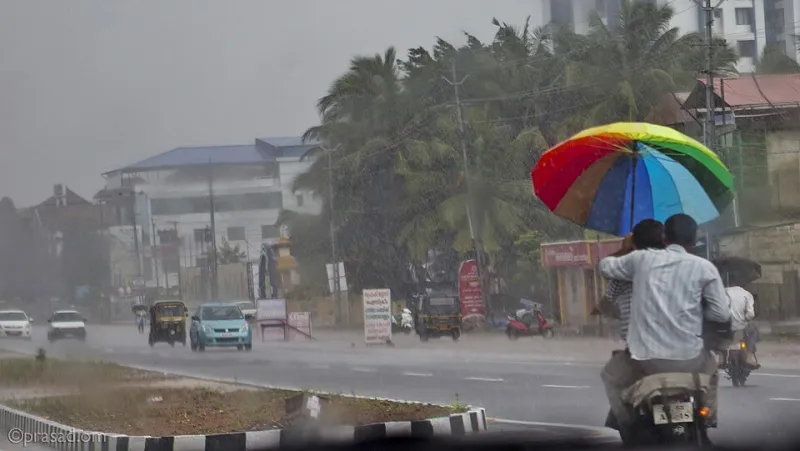
Rain, Rhythm, and Reel: How Kerala's Monsoon Became Malayalam Cinema's Secret Ingredient
Photo: Prasad Pillai from Muscat, Oman, CC BY 2.0, via Wikimedia Commons
There's a reason so many of your favorite Malayalam films feel like they're soaked in something — a particular mood, a heaviness, a kind of beauty that's almost hard to name. Chances are, that feeling has a lot to do with rain. Not the dramatic Hollywood kind that shows up right before a plot twist, but the slow, relentless, deeply atmospheric monsoon that descends on Kerala every June and doesn't really leave until October.
For anyone watching from Phoenix or Portland or the suburbs of New Jersey, that seasonal reality might feel abstract. But for Kerala's filmmakers, the monsoon is basically an uninvited co-director — one who shows up on set every year, rewrites the schedule, and somehow makes everything look better on camera.
The Climate as Creative Collaborator
Here's the thing about shooting in Kerala during monsoon season: you don't really have a choice about whether to include the rain. It's just there. And over decades, that practical reality evolved into something more intentional — filmmakers started designing around it, leaning into the grey skies and waterlogged landscapes instead of fighting them.
Cinematographers working in Malayalam cinema have long talked about the quality of monsoon light as something genuinely special. The overcast sky acts like a massive natural softbox, diffusing sunlight in a way that's almost impossible to replicate artificially. Skin tones read differently. Green foliage goes almost luminescent. Water on every surface creates natural reflections that give frames a layered, painterly quality.
That visual richness isn't accidental — it's baked into the production calendar. Many Malayalam productions time their outdoor shoots specifically to capture that monsoon atmosphere, even when the story isn't explicitly set during the rainy season. The weather becomes a texture, a feeling that audiences absorb without always consciously registering it.
Storytelling That Smells Like Wet Earth
Beyond the visuals, the monsoon has a way of shaping what stories get told and how they unfold. Think about it: when half the year brings a season that keeps people indoors, slows down routines, and creates a particular kind of introspective quiet, that psychological reality seeps into the narratives that emerge from that culture.
Malayalam cinema has a long tradition of intimate, character-driven storytelling — films where the real drama happens in conversations, in silences, in the way two people exist in the same space without quite reaching each other. That kind of storytelling feels native to a climate that forces stillness. When you can't go anywhere because the roads are flooded and the rain is relentless, you're left with yourself and whoever's in the room with you.
Some of the most celebrated Malayalam films of recent decades — the kind that show up in festival circuits and eventually land on your streaming queue — use rain not just as a backdrop but as an emotional signal. A sudden downpour interrupts a conversation that needed interrupting. A character stands in the rain because standing inside would mean confronting something they're not ready to face. The monsoon becomes a narrative tool, one so culturally embedded that viewers raised in Kerala read it intuitively.
For US viewers, that same imagery might read as atmospheric but not necessarily meaningful in the same layered way. Understanding the cultural weight of the monsoon — the fact that it marks a specific, almost sacred shift in Kerala's annual rhythm — adds a whole dimension to how you experience these films.
Production Realities: The Monsoon as Both Muse and Menace
Of course, it's not all cinematic poetry. Shooting during monsoon season comes with genuinely brutal logistical challenges. Equipment gets damaged. Outdoor locations become inaccessible. Crew members get sick. Schedules collapse.
Smaller Malayalam productions, which operate on budgets that would barely cover catering on a Bollywood set, don't have the resources to simply wait out the weather or build elaborate studio replications of outdoor environments. That constraint has historically pushed filmmakers toward resourcefulness — finding ways to use what's available rather than manufacturing what isn't.
There's an argument to be made that this constraint is part of what gives Malayalam cinema its distinctive aesthetic. When you can't afford to control everything, you learn to collaborate with your environment. The rain gets into the film because there was no keeping it out, and then it turns out the rain was exactly what the film needed.
What Diaspora Viewers Bring to the Screen
For Keralites living in the US, there's something emotionally layered about watching monsoon-soaked Malayalam films from a climate that doesn't have anything like that season. Whether you're in Los Angeles dealing with drought conditions or in Chicago watching a very different kind of grey sky, the monsoon in these films carries a specific nostalgia that functions almost like a memory trigger.
Community screenings of Malayalam films in cities like Houston, Chicago, and the Bay Area often see audiences respond viscerally to rain sequences — a kind of collective recognition that goes beyond plot or character. You're watching weather that you grew up with, weather that smells a certain way and sounds a certain way, and suddenly a streaming platform or a community theater screen is doing something that no amount of phone calls home can quite replicate.
For viewers who didn't grow up in Kerala — whether you're a film enthusiast who found Malayalam cinema through festival recommendations or a partner who got pulled in by a spouse's nostalgia — understanding the monsoon dimension is genuinely useful context. It explains a lot about why these films feel the way they feel.
Finding the Monsoon in Your Queue
If you want to start paying attention to this geography-cinema connection, here are a few things to watch for next time you're browsing your streaming options:
- Light quality: Notice how outdoor scenes in Kerala-set films have a particular softness and depth. That's the monsoon sky at work, even when it isn't actively raining in the scene.
- Pacing: Many Malayalam films slow down in ways that American audiences sometimes find challenging. That rhythm reflects a cultural relationship with time that the monsoon season reinforces — the sense that some things just have to be waited out.
- Water as symbol: Pay attention to how rain, rivers, and flooding are used as emotional punctuation. It's rarely incidental.
- Interior scenes: Some of the most powerful Malayalam films are essentially chamber dramas — small groups of people in confined spaces. That's monsoon storytelling in its purest form.
The monsoon isn't a backdrop. It's a collaborator, a tradition, and for millions of viewers watching from the other side of the world, it's also a way home.