Whoever Keeps Putting That Breathy Acoustic Guitar in Every Sad Scene, We Need to Talk
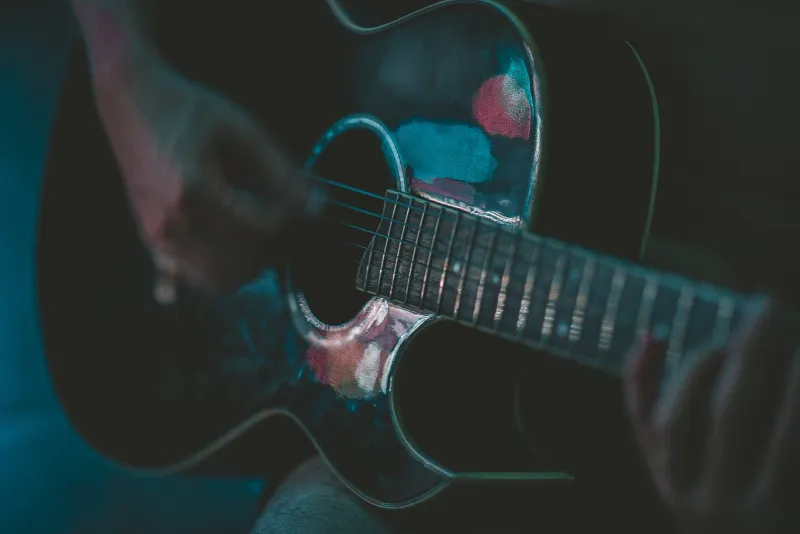
Picture the scene. A young woman stares out a rain-streaked window. A relationship has just ended, or a parent has just died, or a dream has just crumbled in a particularly photogenic way. And right on cue — like a sommelier who only knows one wine — the music arrives. Acoustic guitar. Female vocalist. Tempo somewhere between a dirge and a lullaby. Lyrics that are technically words but function more like warm fog. The melody climbs. The character's chin trembles. You feel... something. Or you used to.
Because here's the thing. You've felt this exact something approximately four hundred times now. And the four hundredth time you feel a thing, you start wondering whether you're actually feeling it or just recognizing the instruction to feel it.
How We Got Here: A Brief History of Sonic Manipulation
Film music has always been in the business of telling you what to feel before you've decided what to feel. Bernard Herrmann shrieked strings at you in Psycho. John Williams made you love a shark you hadn't even seen yet in Jaws. Ennio Morricone made the American West sound like a philosophical argument. These composers understood that music doesn't accompany emotion in film — it creates it, then hands the bill to the visuals.
But somewhere around the mid-2000s, a different school of thought took hold. Garden State put the Shins on the map and, in doing so, accidentally established a template that the industry has been Xeroxing ever since: quirky indie folk as the emotional grammar of serious-feeling cinema. Zach Braff did not invent the sad acoustic song, but he did arguably industrialize it.
From there, the lineage is traceable and relentless. 500 Days of Summer. Silver Linings Playbook. Essentially every prestige drama that aired on any streaming platform between 2015 and now. The formula calcified. Sad moment? Breathy singer-songwriter. Hopeful moment? Slightly less breathy singer-songwriter, maybe with a tambourine. Ambiguous ending? Instrumental version of the same song you've already heard twice.
The Streaming Platform Industrial Acoustic Complex
Netflix, Hulu, Apple TV+, Max — they have all drunk deeply from this particular well. Original films and prestige limited series on streaming platforms are, as a category, aggressively committed to the sad indie song as emotional infrastructure. Part of this is budget: licensing or commissioning an original orchestral score is expensive. A singer-songwriter recording a melancholy track in a well-lit studio is comparatively affordable and, crucially, searchable. The song goes on Spotify. The Spotify listeners find the show. The algorithm is pleased. Everyone wins except the audience's capacity for genuine surprise.
The other part of this is risk aversion. Studios and platforms are deeply afraid of scoring a sad scene wrong — of accidentally making it unintentionally funny, or cold, or confusing. The indie folk song is a pre-tested emotional delivery vehicle. It has cultural associations with sincerity, with authenticity, with feelings that are real and adult and not embarrassing. Slap it under a breakup scene and you're essentially buying emotional insurance.
What Gets Lost in the Translation
Here's what the acoustic guitar monoculture actually costs cinema: specificity. One of the most powerful things a film score can do is tell you something about this particular story that no other story has. Bernard Herrmann's Taxi Driver score sounds like urban paranoia made audible. Jonny Greenwood's work for Paul Thomas Anderson sounds like dread wearing a three-piece suit. These scores don't just accompany the films — they are the films, in some essential way.
When every film reaches for the same sonic shorthand, the scores become interchangeable. And when scores become interchangeable, films start to blur together in memory. You remember the feeling — that warm, slightly melancholy feeling — but you can't remember which film gave it to you. Because twelve films gave it to you. With the same song.
There are directors who still refuse the template. Ari Aster scores his horror films with a discomfort that no amount of acoustic guitar could approximate. Greta Gerwig's Barbie used a pop maximalism that was deliberately, gleefully wrong in all the right ways. Denis Villeneuve and composer Hans Zimmer built Dune a soundscape that felt genuinely alien. These choices are noticed precisely because they're rare.
The Audience Is Starting to Notice
There's a particular kind of viewer fatigue that sets in when you feel manipulated rather than moved. The sad indie song has, through sheer repetition, started to read as a manipulation rather than an invitation. Film-literate audiences — and streaming culture has, paradoxically, created more of them — now recognize the sonic cue before the emotion has a chance to land organically. The guitar starts. The brain says: this is the sad part. The heart, receiving instructions rather than an experience, complies with something less than full commitment.
This is the paradox at the center of the whole thing. The sad indie song became ubiquitous because it worked. It continues to be used because it works. But the more it's used, the less it works. It is a self-defeating formula that the industry is too comfortable to abandon.
A Plea for Sonic Courage
Here is an extremely modest proposal: try something weird. Try silence. Try a song that's genuinely wrong for the moment and see what happens. Try an orchestral score that doesn't tell audiences what to feel but instead asks them a question. Try scoring a heartbreak scene with something that sounds like joy, and trust the audience to hold both things at once.
The movies that stay with you are almost never the ones that told you exactly how to feel. They're the ones that created a space where you figured it out yourself — and the music was part of that space, not a sign pointing at it.
Somewhere out there, a director is about to put a breathy acoustic song under a rain-streaked window shot. We're begging. Just this once. Try the tambourine.